

The challenge of mobile connectivity in modern high-rises
Inside high-rise buildings, shopping centers, hotels, and luxury residential complexes, mobile signals are frequently and severely degraded due to multiple compounding factors: modern construction materials — reinforced concrete, heat-reflective glass, metal-clad walls — act as invisible shields blocking radio signals from penetrating; tall buildings also suffer from interference caused by multiple surrounding BTS towers; and high concentrations of users in a confined space can overload the network, leading to a poor connection experience. The result is dropped calls, interrupted data, and complete signal loss in basements, elevators, corridors, and enclosed spaces — precisely when users need connectivity most.
In reality, 80% of all mobile calls are made indoors, yet in-building coverage remains the persistent weak point of traditional network infrastructure. This is where DAS — Distributed Antenna System — technology becomes indispensable.
What is DAS / IBC?
A DAS is a network of antennas distributed throughout a building or campus, connected to a central signal source, designed to eliminate dead zones and improve both coverage and network capacity. A single DAS system can simultaneously serve multiple mobile carriers.
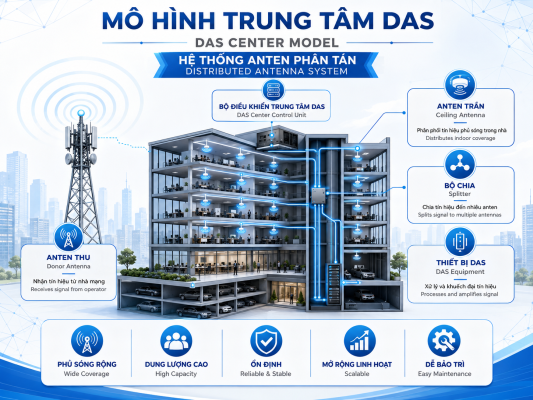
In terms of how it works: the system receives signal from the carrier’s network — either via an outdoor donor antenna or a direct connection to a base transceiver station (BTS) — amplifies it, and redistributes it through a network of strategically placed indoor antennas. Every area of the building receives a strong, stable signal without exception: the deepest basement, the fastest elevator, and the most acoustically sealed meeting room.
DAS system architectures
Depending on the scale and technical requirements of each project, DAS is deployed in three primary architectures:
Passive DAS: Uses coaxial cable together with signal splitters and a rooftop donor antenna. Lower upfront investment, suited to small and medium-sized buildings with moderate user density.
Active DAS: Uses fiber optic infrastructure and Remote Radio Units (RRUs) to transmit digital signals to each distribution point, enabling high-quality coverage across large floor areas and supporting a significantly greater number of simultaneous users. This is the industry standard for Grade-A office towers, large commercial centers, and five-star hotels.
Hybrid DAS: Combines the strengths of both architectures — fiber optic for the building’s vertical riser and coaxial cable for horizontal floor distribution — delivering an ideal balance between performance and capital expenditure. The architecture is also readily scalable as demand grows.
5G-ready and future-proof
Over 80% of mobile data traffic originates indoors, yet higher-frequency 5G signals — particularly C-Band and mmWave — are effectively blocked by most modern building materials, including standard glass. As a result, DAS infrastructure is no longer optional; it is a prerequisite for any building that intends to deliver genuine 5G connectivity to its residents and tenants.
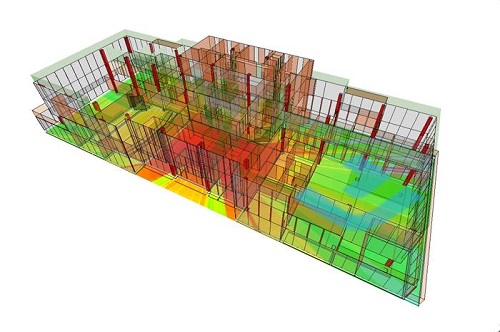
A properly engineered DAS system is designed to support emerging technologies such as 5G and IoT, making it a durable and high-value infrastructure investment for the long term.
Comprehensive benefits — value for every stakeholder
A high-quality IBC/DAS system simultaneously delivers measurable benefits to all parties involved:
Developers & Building Management:
- Increases property value and tenant satisfaction; ensures compliance with current building standards relating to communications infrastructure.
- Strengthens the building’s competitive position against comparable developments in the same segment.
Residents, office tenants & hotel guests:
- Uninterrupted connectivity — voice, data, video — at every location within the building, without exception.
- Complete elimination of dead zones in stairwells, underground parking, elevators, and service areas.
Mobile network operators:
- Extends high-quality coverage deep into key buildings without additional investment in external BTS infrastructure.
- Improves Quality of Service (QoS) metrics, reduces call drop rates, and increases data revenue.
ARtek® — your trusted IBC deployment partner
ARtek® specializes in the investment and deployment of in-building mobile coverage systems (IBC/DAS), serving as a strategic partner to Vietnam’s leading mobile carriers including Vinaphone, Mobifone, and Viettel. With a growing project portfolio spanning the entire country — from Grade-A office buildings and premium residential towers to five-star hotels — ARtek® delivers DAS solutions engineered specifically to the characteristics of each building.
Every system ARtek® deploys guarantees high-quality signal coverage, network capacity scaled to high subscriber density, zero congestion, zero dropped calls — including inside high-speed elevators. From site survey, system design, and carrier coordination through to installation and commissioning, ARtek® manages the entire end-to-end process — allowing developers to optimize both time and cost while meeting the highest technical standards in the industry.
A DAS/IBC system today is far more than a technical solution — it is essential infrastructure that defines the living and working experience in every modern building.